The Cell Membrane Can Better Store Charge if
The Cellular Level of Organization
The Cell Membrane
Learning Objectives
Past the stop of this section, you will be able to:
- Draw the molecular components that make up the prison cell membrane
- Explain the major features and backdrop of the prison cell membrane
- Differentiate between materials that tin can and cannot lengthened through the lipid bilayer
- Compare and contrast unlike types of passive transport with active transport, providing examples of each
Despite differences in structure and office, all living cells in multicellular organisms have a surrounding prison cell membrane. Equally the outer layer of your skin separates your body from its environment, the cell membrane (too known equally the plasma membrane) separates the inner contents of a prison cell from its exterior surroundings. This cell membrane provides a protective bulwark effectually the cell and regulates which materials can pass in or out.
Structure and Composition of the Cell Membrane
The jail cell membrane is an extremely pliable structure equanimous primarily of dorsum-to-back phospholipids (a "bilayer"). Cholesterol is too present, which contributes to the fluidity of the membrane, and there are diverse proteins embedded within the membrane that accept a diversity of functions.
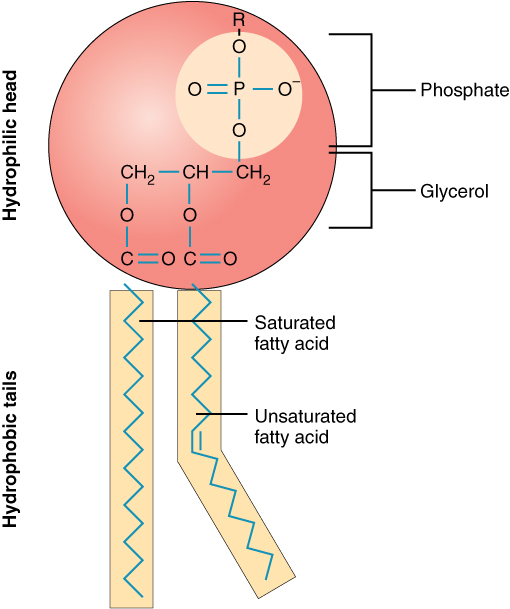
A unmarried phospholipid molecule has a phosphate group on one finish, called the "head," and two side-by-side chains of fatty acids that brand up the lipid tails ((Figure)). The phosphate group is negatively charged, making the head polar and hydrophilic—or "h2o loving." A hydrophilic molecule (or region of a molecule) is one that is attracted to water. The phosphate heads are thus attracted to the water molecules of both the extracellular and intracellular environments. The lipid tails, on the other manus, are uncharged, or nonpolar, and are hydrophobic—or "water fearing." A hydrophobic molecule (or region of a molecule) repels and is repelled by h2o. Some lipid tails consist of saturated fatty acids and some incorporate unsaturated fatty acids. This combination adds to the fluidity of the tails that are constantly in motion. Phospholipids are thus amphipathic molecules. An amphipathic molecule is one that contains both a hydrophilic and a hydrophobic region. In fact, lather works to remove oil and grease stains because information technology has amphipathic backdrop. The hydrophilic portion can dissolve in h2o while the hydrophobic portion can trap grease in micelles that then tin can exist washed away.
Phospholipid Structure
A phospholipid molecule consists of a polar phosphate "head," which is hydrophilic and a non-polar lipid "tail," which is hydrophobic. Unsaturated fat acids result in kinks in the hydrophobic tails.
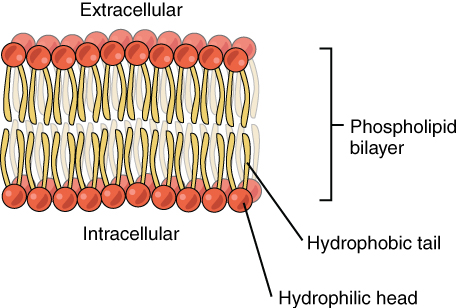
The cell membrane consists of two adjacent layers of phospholipids. The lipid tails of one layer face the lipid tails of the other layer, meeting at the interface of the two layers. The phospholipid heads face outward, i layer exposed to the interior of the cell and one layer exposed to the outside ((Effigy)). Because the phosphate groups are polar and hydrophilic, they are attracted to water in the intracellular fluid. Intracellular fluid (ICF) is the fluid interior of the cell. The phosphate groups are also attracted to the extracellular fluid. Extracellular fluid (ECF) is the fluid surround outside the enclosure of the cell membrane. Interstitial fluid (IF) is the term given to extracellular fluid not contained within blood vessels. Considering the lipid tails are hydrophobic, they meet in the inner region of the membrane, excluding watery intracellular and extracellular fluid from this space. The cell membrane has many proteins, likewise as other lipids (such equally cholesterol), that are associated with the phospholipid bilayer. An of import feature of the membrane is that it remains fluid; the lipids and proteins in the cell membrane are not rigidly locked in identify.
Phospolipid Bilayer
The phospholipid bilayer consists of two adjacent sheets of phospholipids, arranged tail to tail. The hydrophobic tails associate with one another, forming the interior of the membrane. The polar heads contact the fluid inside and outside of the cell.
Membrane Proteins
The lipid bilayer forms the footing of the prison cell membrane, but information technology is peppered throughout with various proteins. 2 different types of proteins that are commonly associated with the prison cell membrane are the integral proteins and peripheral protein ((Figure)). Equally its name suggests, an integral poly peptide is a protein that is embedded in the membrane. A aqueduct protein is an example of an integral poly peptide that selectively allows particular materials, such as sure ions, to pass into or out of the cell.
Jail cell Membrane
The prison cell membrane of the cell is a phospholipid bilayer containing many different molecular components, including proteins and cholesterol, some with sugar groups attached.

Some other important group of integral proteins are cell recognition proteins, which serve to mark a jail cell'due south identity then that information technology can be recognized by other cells. A receptor is a blazon of recognition poly peptide that can selectively bind a specific molecule outside the cell, and this binding induces a chemical reaction within the cell. A ligand is the specific molecule that binds to and activates a receptor. Some integral proteins serve dual roles as both a receptor and an ion channel. One example of a receptor-ligand interaction is the receptors on nerve cells that bind neurotransmitters, such equally dopamine. When a dopamine molecule binds to a dopamine receptor protein, a channel within the transmembrane protein opens to allow sure ions to flow into the prison cell.
Some integral membrane proteins are glycoproteins. A glycoprotein is a protein that has sugar molecules attached, which extend into the extracellular matrix. The attached carbohydrate tags on glycoproteins aid in jail cell recognition. The carbohydrates that extend from membrane proteins and even from some membrane lipids collectively form the glycocalyx. The glycocalyx is a fuzzy-appearing coating around the prison cell formed from glycoproteins and other carbohydrates attached to the prison cell membrane. The glycocalyx tin have various roles. For example, information technology may accept molecules that let the cell to bind to another cell, information technology may contain receptors for hormones, or information technology might accept enzymes to intermission downwardly nutrients. The glycocalyces found in a person's body are products of that person's genetic makeup. They give each of the private's trillions of cells the "identity" of belonging in the person's body. This identity is the primary way that a person'southward immune defense cells "know" non to attack the person'southward own trunk cells, but information technology also is the reason organs donated by another person might be rejected.
Peripheral proteins are typically found on the inner or outer surface of the lipid bilayer but can also exist fastened to the internal or external surface of an integral protein. These proteins typically perform a specific function for the cell. Some peripheral proteins on the surface of intestinal cells, for case, act as digestive enzymes to break down nutrients to sizes that tin pass through the cells and into the bloodstream.
Transport across the Cell Membrane
One of the great wonders of the jail cell membrane is its ability to regulate the concentration of substances inside the jail cell. These substances include ions such equally Ca++, Na+, K+, and Cl–; nutrients including sugars, fatty acids, and amino acids; and waste products, specially carbon dioxide (CO2), which must exit the prison cell.
The membrane's lipid bilayer construction provides the offset level of command. The phospholipids are tightly packed together, and the membrane has a hydrophobic interior. This structure causes the membrane to exist selectively permeable. A membrane that has selective permeability allows only substances meeting sure criteria to pass through it unaided. In the instance of the cell membrane, simply relatively small, nonpolar materials can move through the lipid bilayer (recall, the lipid tails of the membrane are nonpolar). Some examples of these are other lipids, oxygen and carbon dioxide gases, and alcohol. However, water-soluble materials—like glucose, amino acids, and electrolytes—need some help to cantankerous the membrane considering they are repelled by the hydrophobic tails of the phospholipid bilayer. All substances that motion through the membrane exercise so by one of two general methods, which are categorized based on whether or not energy is required. Passive send is the movement of substances across the membrane without the expenditure of cellular free energy. In contrast, active transport is the motion of substances beyond the membrane using energy from adenosine triphosphate (ATP).
Passive Transport
In order to sympathize how substances move passively across a cell membrane, it is necessary to empathise concentration gradients and improvidence. A concentration gradient is the deviation in concentration of a substance across a space. Molecules (or ions) will spread/diffuse from where they are more concentrated to where they are less concentrated until they are every bit distributed in that space. (When molecules move in this way, they are said to move down their concentration gradient.) Diffusion is the motility of particles from an area of higher concentration to an surface area of lower concentration. A couple of common examples will assistance to illustrate this concept. Imagine being within a airtight bathroom. If a bottle of perfume were sprayed, the scent molecules would naturally diffuse from the spot where they left the canteen to all corners of the bathroom, and this diffusion would go on until no more concentration gradient remains. Another instance is a spoonful of sugar placed in a loving cup of tea. Eventually the sugar will diffuse throughout the tea until no concentration gradient remains. In both cases, if the room is warmer or the tea hotter, diffusion occurs even faster as the molecules are bumping into each other and spreading out faster than at libation temperatures. Having an internal body temperature around 98.6° F thus also aids in diffusion of particles within the body.
Visit this link to meet diffusion and how information technology is propelled by the kinetic energy of molecules in solution. How does temperature affect diffusion rate, and why?
Whenever a substance exists in greater concentration on one side of a semipermeable membrane, such as the prison cell membranes, any substance that tin can motility down its concentration slope across the membrane volition do so. Consider substances that can easily diffuse through the lipid bilayer of the prison cell membrane, such as the gases oxygen (O2) and CO2. O2 mostly diffuses into cells because it is more concentrated outside of them, and CO2 typically diffuses out of cells because it is more concentrated inside of them. Neither of these examples requires whatsoever energy on the part of the cell, and therefore they utilise passive transport to move across the membrane.
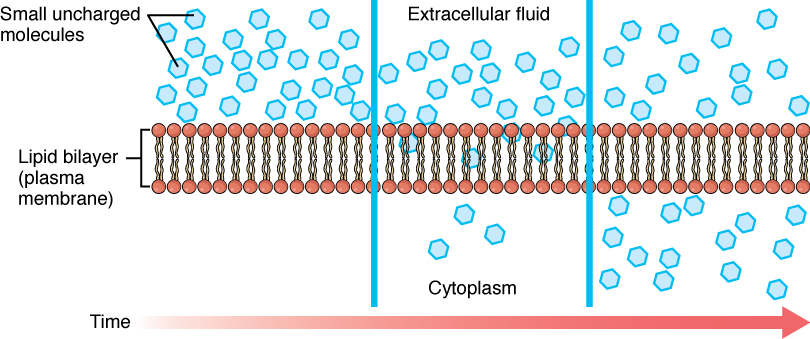
Before moving on, yous need to review the gases that tin diffuse across a jail cell membrane. Because cells quickly use up oxygen during metabolism, there is typically a lower concentration of O2 inside the cell than outside. Equally a result, oxygen will diffuse from the interstitial fluid directly through the lipid bilayer of the membrane and into the cytoplasm within the prison cell. On the other hand, because cells produce CO2 as a byproduct of metabolism, CO2 concentrations rise within the cytoplasm; therefore, CO2 will motion from the cell through the lipid bilayer and into the interstitial fluid, where its concentration is lower. This machinery of molecules moving across a cell membrane from the side where they are more concentrated to the side where they are less full-bodied is a form of passive transport called simple diffusion ((Figure)).
Simple Diffusion beyond the Cell (Plasma) Membrane
The structure of the lipid bilayer allows pocket-size, uncharged substances such as oxygen and carbon dioxide, and hydrophobic molecules such as lipids, to pass through the cell membrane, down their concentration slope, past simple improvidence.
Big polar or ionic molecules, which are hydrophilic, cannot easily cantankerous the phospholipid bilayer. Very small polar molecules, such as h2o, can cantankerous via unproblematic diffusion due to their small size. Charged atoms or molecules of whatsoever size cannot cross the cell membrane via uncomplicated diffusion as the charges are repelled by the hydrophobic tails in the interior of the phospholipid bilayer. Solutes dissolved in h2o on either side of the cell membrane will tend to lengthened downwards their concentration gradients, only because most substances cannot pass freely through the lipid bilayer of the cell membrane, their movement is restricted to protein channels and specialized send mechanisms in the membrane. Facilitated diffusion is the diffusion process used for those substances that cannot cross the lipid bilayer due to their size, charge, and/or polarity ((Effigy)). A common instance of facilitated diffusion is the movement of glucose into the cell, where it is used to make ATP. Although glucose can be more concentrated exterior of a prison cell, information technology cannot cross the lipid bilayer via unproblematic diffusion considering information technology is both large and polar. To resolve this, a specialized carrier protein chosen the glucose transporter will transfer glucose molecules into the cell to facilitate its inward improvidence.
Facilitated Diffusion
(a) Facilitated diffusion of substances crossing the cell (plasma) membrane takes place with the help of proteins such as channel proteins and carrier proteins. Aqueduct proteins are less selective than carrier proteins, and usually mildly discriminate between their cargo based on size and accuse. (b) Carrier proteins are more than selective, oftentimes simply allowing one item type of molecule to cross.
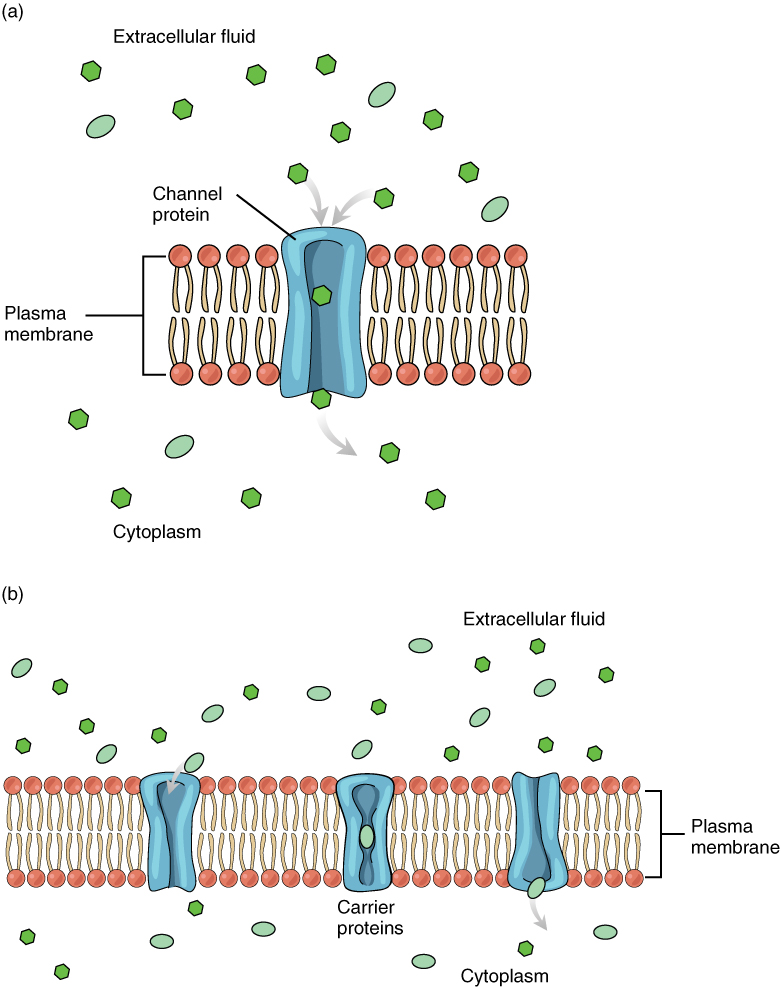
As an example, even though sodium ions (Na+) are highly full-bodied outside of cells, these electrolytes are charged and cannot pass through the nonpolar lipid bilayer of the membrane. Their diffusion is facilitated by membrane proteins that form sodium channels (or "pores"), and so that Na+ ions can move downwardly their concentration gradient from outside the cells to inside the cells. There are many other solutes that must undergo facilitated diffusion to move into a cell, such as amino acids, or to move out of a cell, such equally wastes. Because facilitated improvidence is a passive procedure, information technology does non require energy expenditure by the cell.
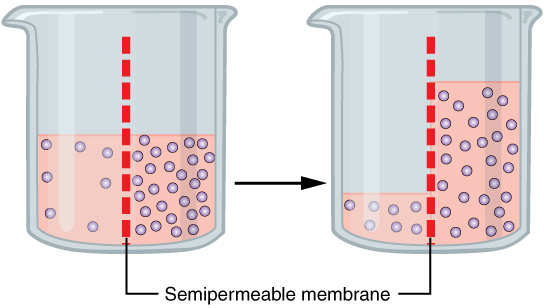
Water also can move freely across the cell membrane of all cells, either through protein channels or past slipping between the lipid tails of the membrane itself. Osmosis is the diffusion of water through a semipermeable membrane ((Figure)).
Osmosis
Osmosis is the diffusion of water through a semipermeable membrane downwards its concentration gradient. If a membrane is permeable to water, though not to a solute, water will equalize its own concentration past diffusing to the side of lower water concentration (and thus the side of higher solute concentration). In the chalice on the left, the solution on the correct side of the membrane is hypertonic.
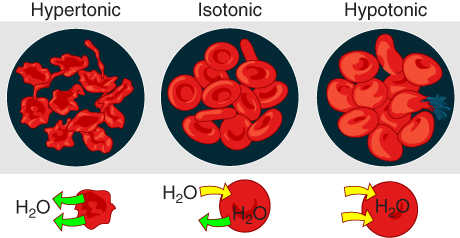
The movement of water molecules is not itself regulated by cells, so it is important that cells are exposed to an environment in which the concentration of solutes outside of the cells (in the extracellular fluid) is equal to the concentration of solutes inside the cells (in the cytoplasm). Two solutions that have the same concentration of solutes are said to be isotonic (equal tension). When cells and their extracellular environments are isotonic, the concentration of water molecules is the same exterior and inside the cells, and the cells maintain their normal shape (and office).
Osmosis occurs when in that location is an imbalance of solutes exterior of a prison cell versus inside the cell. A solution that has a college concentration of solutes than some other solution is said to exist hypertonic, and water molecules tend to diffuse into a hypertonic solution ((Effigy)). Cells in a hypertonic solution will shrivel equally water leaves the cell via osmosis. In dissimilarity, a solution that has a lower concentration of solutes than another solution is said to exist hypotonic, and water molecules tend to diffuse out of a hypotonic solution. Cells in a hypotonic solution will have on also much water and corking, with the risk of eventually bursting. A critical attribute of homeostasis in living things is to create an internal environment in which all of the body's cells are in an isotonic solution. Diverse organ systems, particularly the kidneys, piece of work to maintain this homeostasis.
Concentration of Solutions
A hypertonic solution has a solute concentration college than some other solution. An isotonic solution has a solute concentration equal to another solution. A hypotonic solution has a solute concentration lower than another solution.
Another mechanism besides diffusion to passively transport materials between compartments is filtration. Unlike diffusion of a substance from where information technology is more than full-bodied to less concentrated, filtration uses a hydrostatic pressure level gradient that pushes the fluid—and the solutes within it—from a higher pressure surface area to a lower force per unit area area. Filtration is an extremely important process in the body. For example, the circulatory organization uses filtration to move plasma and substances across the endothelial lining of capillaries and into surrounding tissues, supplying cells with the nutrients. Filtration pressure in the kidneys provides the mechanism to remove wastes from the bloodstream.
Active Send
For all of the ship methods described higher up, the cell expends no energy. Membrane proteins that aid in the passive transport of substances practice so without the use of ATP. During active transport, ATP is required to move a substance across a membrane, frequently with the help of protein carriers, and usually against its concentration gradient.
One of the most common types of active send involves proteins that serve every bit pumps. The word "pump" probably conjures upwards thoughts of using energy to pump up the tire of a bicycle or a basketball game. Similarly, energy from ATP is required for these membrane proteins to ship substances—molecules or ions—across the membrane, usually against their concentration gradients (from an area of depression concentration to an expanse of loftier concentration).
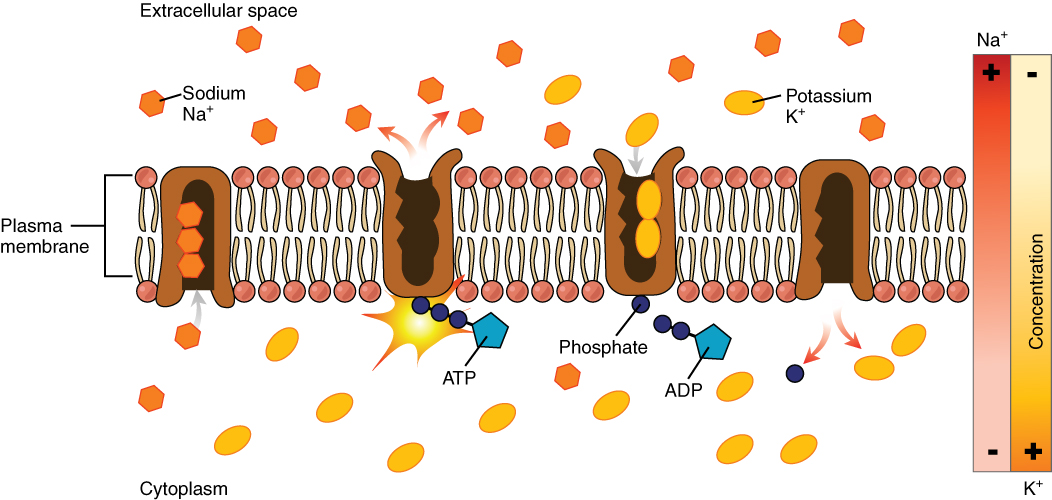
The sodium-potassium pump, which is also called Na+/Grand+ ATPase, transports sodium out of a cell while moving potassium into the cell. The Na+/Grand+ pump is an important ion pump plant in the membranes of many types of cells. These pumps are specially abundant in nerve cells, which are constantly pumping out sodium ions and pulling in potassium ions to maintain an electric gradient beyond their cell membranes. An electrical gradient is a difference in electrical charge across a space. In the case of nerve cells, for example, the electrical gradient exists between the within and exterior of the cell, with the within being negatively-charged (at effectually -70 mV) relative to the exterior. The negative electrical gradient is maintained because each Na+/Grand+ pump moves three Na+ ions out of the jail cell and two Thousand+ ions into the prison cell for each ATP molecule that is used ((Effigy)). This process is and then important for nervus cells that information technology accounts for the majority of their ATP usage.
Sodium-Potassium Pump
The sodium-potassium pump is institute in many cell (plasma) membranes. Powered past ATP, the pump moves sodium and potassium ions in contrary directions, each against its concentration gradient. In a single bicycle of the pump, three sodium ions are extruded from and two potassium ions are imported into the cell.
Active ship pumps tin also piece of work together with other active or passive ship systems to movement substances beyond the membrane. For case, the sodium-potassium pump maintains a high concentration of sodium ions exterior of the jail cell. Therefore, if the cell needs sodium ions, all it has to do is open a passive sodium channel, as the concentration gradient of the sodium ions will drive them to diffuse into the prison cell. In this manner, the action of an active transport pump (the sodium-potassium pump) powers the passive transport of sodium ions by creating a concentration gradient. When active transport powers the transport of some other substance in this way, it is called secondary agile transport.
Symporters are secondary agile transporters that move two substances in the same management. For case, the sodium-glucose symporter uses sodium ions to "pull" glucose molecules into the jail cell. Considering cells store glucose for energy, glucose is typically at a higher concentration inside of the cell than outside. All the same, due to the action of the sodium-potassium pump, sodium ions will easily diffuse into the prison cell when the symporter is opened. The flood of sodium ions through the symporter provides the energy that allows glucose to motility through the symporter and into the cell, against its concentration gradient.
Conversely, antiporters are secondary agile transport systems that transport substances in opposite directions. For case, the sodium-hydrogen ion antiporter uses the free energy from the inward flood of sodium ions to movement hydrogen ions (H+) out of the jail cell. The sodium-hydrogen antiporter is used to maintain the pH of the cell'southward interior.
Other forms of active transport do not involve membrane carriers. Endocytosis (bringing "into the jail cell") is the process of a cell ingesting material past enveloping it in a portion of its cell membrane, and then pinching off that portion of membrane ((Figure)). In one case pinched off, the portion of membrane and its contents becomes an contained, intracellular vesicle. A vesicle is a membranous sac—a spherical and hollow organelle bounded past a lipid bilayer membrane. Endocytosis often brings materials into the jail cell that must to be broken down or digested. Phagocytosis ("cell eating") is the endocytosis of big particles. Many immune cells appoint in phagocytosis of invading pathogens. Similar little Pac-men, their job is to patrol trunk tissues for unwanted matter, such every bit invading bacterial cells, phagocytize them, and digest them. In contrast to phagocytosis, pinocytosis ("prison cell drinking") brings fluid containing dissolved substances into a jail cell through membrane vesicles.
Three Forms of Endocytosis
Endocytosis is a class of active send in which a cell envelopes extracellular materials using its cell membrane. (a) In phagocytosis, which is relatively nonselective, the cell takes in a big particle. (b) In pinocytosis, the jail cell takes in small particles in fluid. (c) In contrast, receptor-mediated endocytosis is quite selective. When external receptors bind a specific ligand, the cell responds by endocytosing the ligand.
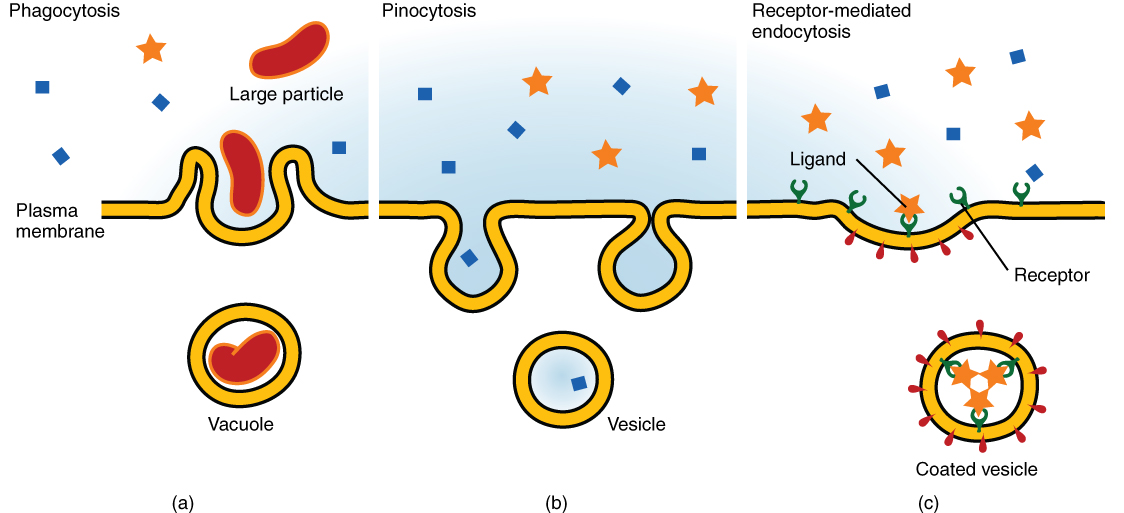
Phagocytosis and pinocytosis take in large portions of extracellular material, and they are typically not highly selective in the substances they bring in. Cells regulate the endocytosis of specific substances via receptor-mediated endocytosis. Receptor-mediated endocytosis is endocytosis past a portion of the cell membrane that contains many receptors that are specific for a sure substance. Once the surface receptors have spring sufficient amounts of the specific substance (the receptor'due south ligand), the cell will endocytose the part of the cell membrane containing the receptor-ligand complexes. Iron, a required component of hemoglobin, is endocytosed past red blood cells in this manner. Iron is bound to a protein chosen transferrin in the blood. Specific transferrin receptors on red blood jail cell surfaces demark the iron-transferrin molecules, and the cell endocytoses the receptor-ligand complexes.
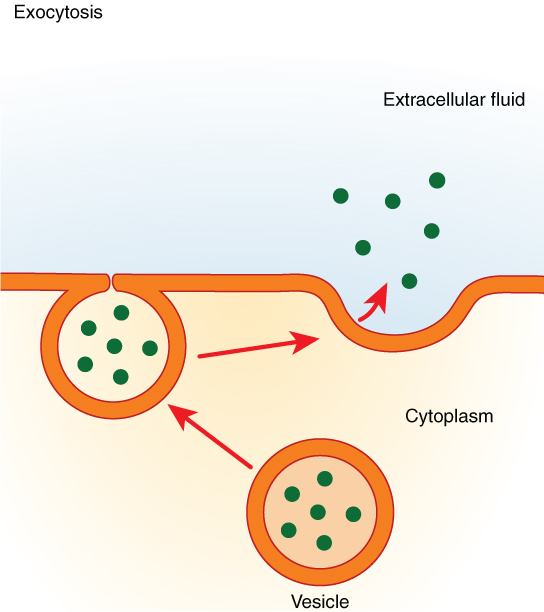
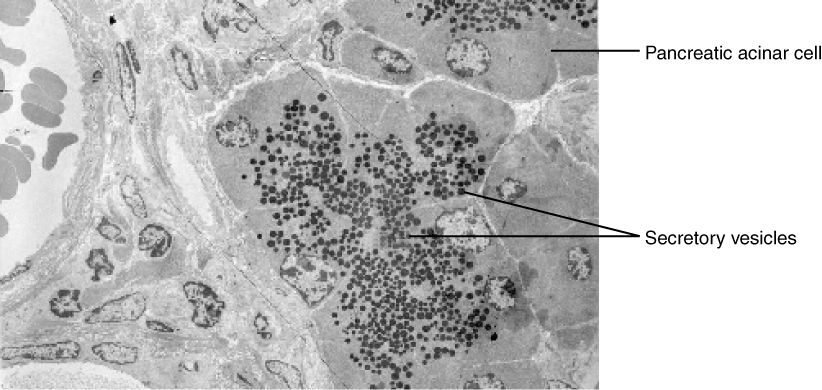
In contrast with endocytosis, exocytosis (taking "out of the cell") is the process of a cell exporting fabric using vesicular transport ((Effigy)). Many cells manufacture substances that must be secreted, similar a factory manufacturing a production for export. These substances are typically packaged into membrane-jump vesicles inside the cell. When the vesicle membrane fuses with the jail cell membrane, the vesicle releases it contents into the interstitial fluid. The vesicle membrane then becomes function of the cell membrane. Cells of the breadbasket and pancreas produce and secrete digestive enzymes through exocytosis ((Figure)). Endocrine cells produce and secrete hormones that are sent throughout the body, and certain allowed cells produce and secrete big amounts of histamine, a chemical important for allowed responses.
Exocytosis
Exocytosis is much like endocytosis in contrary. Fabric destined for export is packaged into a vesicle within the cell. The membrane of the vesicle fuses with the prison cell membrane, and the contents are released into the extracellular space.
Pancreatic Cells' Enzyme Products
The pancreatic acinar cells produce and secrete many enzymes that digest food. The tiny black granules in this electron micrograph are secretory vesicles filled with enzymes that volition be exported from the cells via exocytosis. LM × 2900. (Micrograph provided past the Regents of University of Michigan Medical School © 2012)
Diseases of the…
Cell: Cystic Fibrosis Cystic fibrosis (CF) affects approximately 30,000 people in the United States, with almost 1,000 new cases reported each year. The genetic disease is virtually well known for its damage to the lungs, causing breathing difficulties and chronic lung infections, but it also affects the liver, pancreas, and intestines. Only about 50 years ago, the prognosis for children born with CF was very grim—a life expectancy rarely over 10 years. Today, with advances in medical treatment, many CF patients live into their 30s.
The symptoms of CF result from a malfunctioning membrane ion channel called the cystic fibrosis transmembrane conductance regulator, or CFTR. In healthy people, the CFTR poly peptide is an integral membrane protein that transports Cl– ions out of the cell. In a person who has CF, the cistron for the CFTR is mutated, thus, the cell manufactures a defective channel protein that typically is not incorporated into the membrane, but is instead degraded by the jail cell.
The CFTR requires ATP in order to role, making its Cl– transport a form of active send. This feature puzzled researchers for a long time because the Cl– ions are actually flowing down their concentration gradient when transported out of cells. Agile transport generally pumps ions against their concentration gradient, but the CFTR presents an exception to this rule.
In normal lung tissue, the movement of Cl– out of the prison cell maintains a Cl–-rich, negatively charged environment immediately outside of the cell. This is particularly important in the epithelial lining of the respiratory organization. Respiratory epithelial cells secrete mucus, which serves to trap dust, bacteria, and other debris. A cilium (plural = cilia) is one of the pilus-like appendages found on certain cells. Cilia on the epithelial cells motility the mucus and its trapped particles up the airways abroad from the lungs and toward the outside. In order to exist effectively moved up, the mucus cannot exist too sticky; rather it must have a thin, watery consistency. The ship of Cl– and the maintenance of an electronegative environment outside of the cell attract positive ions such every bit Na+ to the extracellular infinite. The aggregating of both Cl– and Na+ ions in the extracellular infinite creates solute-rich fungus, which has a low concentration of h2o molecules. As a result, through osmosis, water moves from cells and extracellular matrix into the mucus, "thinning" it out. This is how, in a normal respiratory system, the mucus is kept sufficiently watered-down to be propelled out of the respiratory organization.
If the CFTR aqueduct is absent, Cl– ions are non transported out of the cell in adequate numbers, thus preventing them from drawing positive ions. The absence of ions in the secreted mucus results in the lack of a normal water concentration gradient. Thus, at that place is no osmotic pressure level pulling water into the fungus. The resulting mucus is thick and glutinous, and the ciliated epithelia cannot effectively remove it from the respiratory organisation. Passageways in the lungs go blocked with mucus, along with the debris information technology carries. Bacterial infections occur more easily because bacterial cells are not finer carried abroad from the lungs.
Chapter Review
The cell membrane provides a barrier around the cell, separating its internal components from the extracellular environment. Information technology is composed of a phospholipid bilayer, with hydrophobic internal lipid "tails" and hydrophilic external phosphate "heads." Diverse membrane proteins are scattered throughout the bilayer, both inserted within it and attached to information technology peripherally. The cell membrane is selectively permeable, allowing only a limited number of materials to diffuse through its lipid bilayer. All materials that cross the membrane exercise so using passive (not energy-requiring) or active (energy-requiring) send processes. During passive transport, materials motility by simple diffusion or past facilitated improvidence through the membrane, down their concentration gradient. Water passes through the membrane in a diffusion process called osmosis. During active ship, energy is expended to assist material movement across the membrane in a direction against their concentration gradient. Active send may take place with the help of protein pumps or through the use of vesicles.
Interactive Link Questions
Visit this link to meet diffusion and how it is propelled by the kinetic energy of molecules in solution. How does temperature affect diffusion rate, and why?
College temperatures speed upwards improvidence considering molecules have more kinetic energy at higher temperatures.
Review Questions
Because they are embedded within the membrane, ion channels are examples of ________.
- receptor proteins
- integral proteins
- peripheral proteins
- glycoproteins
The diffusion of substances inside a solution tends to move those substances ________ their ________ slope.
- upward; electrical
- up; electrochemical
- down; pressure level
- down; concentration
Ion pumps and phagocytosis are both examples of ________.
- endocytosis
- passive transport
- active transport
- facilitated diffusion
Choose the answer that best completes the following analogy: Diffusion is to ________ as endocytosis is to ________.
- filtration; phagocytosis
- osmosis; pinocytosis
- solutes; fluid
- gradient; chemical energy
Critical Thinking Questions
What materials can easily lengthened through the lipid bilayer, and why?
Only materials that are relatively small and nonpolar can easily lengthened through the lipid bilayer. Large particles cannot fit in between the private phospholipids that are packed together, and polar molecules are repelled by the hydrophobic/nonpolar lipids that line the within of the bilayer.
Why is receptor-mediated endocytosis said to be more selective than phagocytosis or pinocytosis?
Receptor-mediated endocytosis is more selective because the substances that are brought into the cell are the specific ligands that could bind to the receptors beingness endocytosed. Phagocytosis or pinocytosis, on the other mitt, have no such receptor-ligand specificity, and bring in whatever materials happen to be close to the membrane when it is enveloped.
What do osmosis, improvidence, filtration, and the movement of ions abroad from like charge all have in mutual? In what way do they differ?
These 4 phenomena are similar in the sense that they describe the movement of substances down a detail type of gradient. Osmosis and diffusion involve the motion of h2o and other substances downwards their concentration gradients, respectively. Filtration describes the move of particles down a force per unit area slope, and the movement of ions abroad from like charge describes their motility down their electrical gradient.
Glossary
- active transport
- form of transport across the jail cell membrane that requires input of cellular free energy
- amphipathic
- describes a molecule that exhibits a divergence in polarity between its two ends, resulting in a difference in h2o solubility
- prison cell membrane
- membrane surrounding all fauna cells, composed of a lipid bilayer interspersed with various molecules; too known as plasma membrane
- aqueduct protein
- membrane-spanning poly peptide that has an inner pore which allows the passage of one or more than substances
- concentration gradient
- divergence in the concentration of a substance betwixt two regions
- improvidence
- movement of a substance from an expanse of higher concentration to one of lower concentration
- electrical gradient
- deviation in the electrical accuse (potential) between ii regions
- endocytosis
- import of material into the prison cell by formation of a membrane-bound vesicle
- exocytosis
- export of a substance out of a cell past formation of a membrane-bound vesicle
- extracellular fluid (ECF)
- fluid outside to cells; includes the interstitial fluid, blood plasma, and fluid found in other reservoirs in the trunk
- facilitated diffusion
- diffusion of a substance with the aid of a membrane poly peptide
- glycocalyx
- coating of sugar molecules that surrounds the cell membrane
- glycoprotein
- protein that has ane or more carbohydrates attached
- hydrophilic
- describes a substance or construction attracted to water
- hydrophobic
- describes a substance or structure repelled past water
- hypertonic
- describes a solution concentration that is higher than a reference concentration
- hypotonic
- describes a solution concentration that is lower than a reference concentration
- integral protein
- membrane-associated poly peptide that spans the entire width of the lipid bilayer
- interstitial fluid (IF)
- fluid in the small spaces between cells not contained inside blood vessels
- intracellular fluid (ICF)
- fluid in the cytosol of cells
- isotonic
- describes a solution concentration that is the same as a reference concentration
- ligand
- molecule that binds with specificity to a specific receptor molecule
- osmosis
- diffusion of water molecules downward their concentration gradient across a selectively permeable membrane
- passive ship
- form of transport across the jail cell membrane that does non require input of cellular energy
- peripheral protein
- membrane-associated protein that does non span the width of the lipid bilayer, but is attached peripherally to integral proteins, membrane lipids, or other components of the membrane
- phagocytosis
- endocytosis of large particles
- pinocytosis
- endocytosis of fluid
- receptor
- protein molecule that contains a binding site for some other specific molecule (called a ligand)
- receptor-mediated endocytosis
- endocytosis of ligands attached to membrane-jump receptors
- selective permeability
- feature of any bulwark that allows certain substances to cross just excludes others
- sodium-potassium pump
- (too, Na+/1000+ ATP-ase) membrane-embedded protein pump that uses ATP to motility Na+ out of a cell and 1000+ into the prison cell
- vesicle
- membrane-spring structure that contains materials within or outside of the prison cell
Source: https://opentextbc.ca/anatomyandphysiologyopenstax/chapter/the-cell-membrane/
0 Response to "The Cell Membrane Can Better Store Charge if"
Post a Comment